
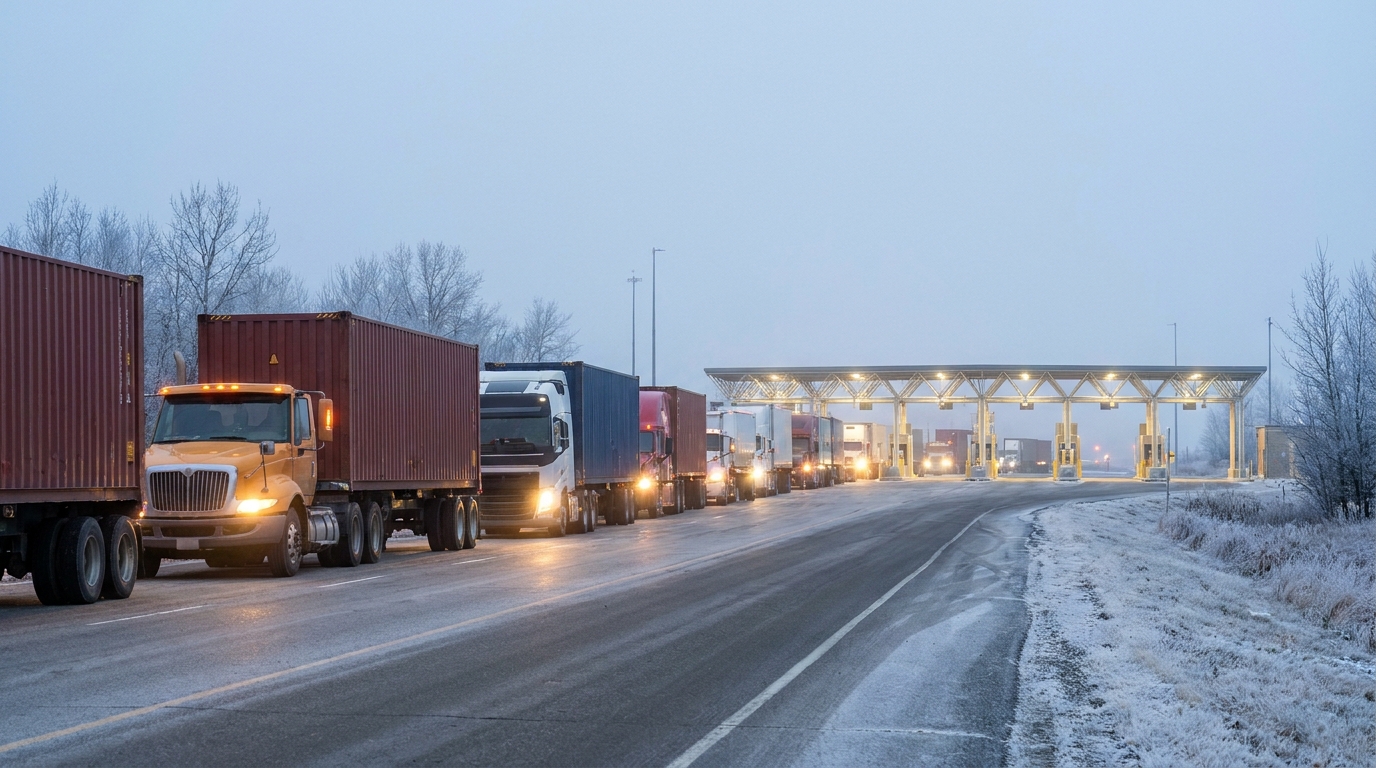
Since 8 September 2026, Canada has charged a surtax of 15%, 25% or 50% on US-origin goods listed in the United States Surtax Order (2026) (CBSA Customs Notice 26-23). On 8 October, the CBSA updated its remission notice so that the existing remission order now covers the 2026 surtax as well (Customs Notice 25-19). Remission means the surtax is waived at the border or refunded afterwards.
Some importers can claim it back. Most importers of goods bought to resell cannot. Here is how to tell which you are and how to claim.
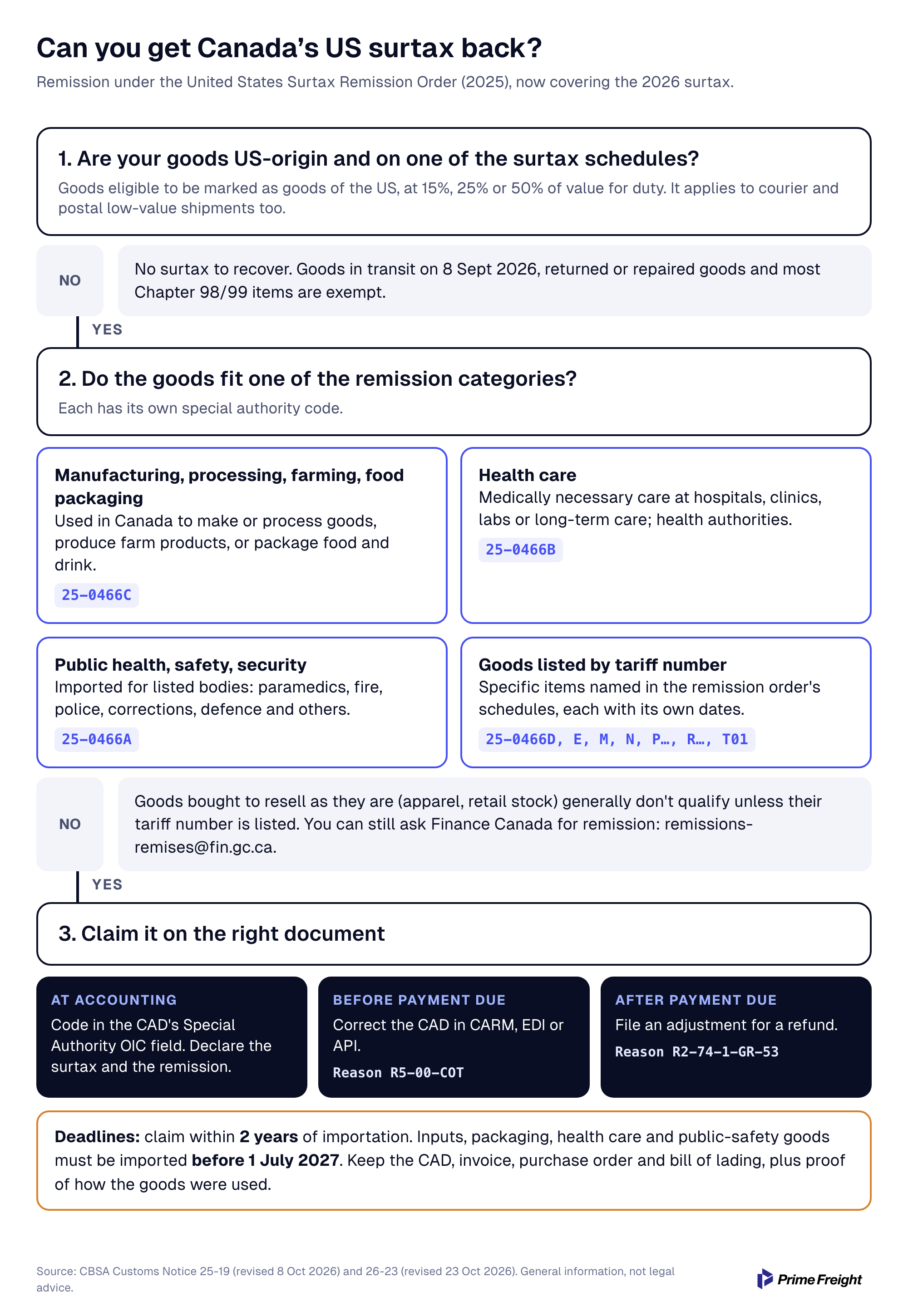
First: does the surtax apply to your goods?
- US-origin, on a schedule. The surtax applies to goods eligible to be marked as goods of the United States and listed in the order's schedules: 15% (Schedule 1), 25% (Schedule 2) or 50% (Schedule 3).
- Calculated on value for duty, on top of any other duties. GST is then charged on a value that includes the surtax.
- Low-value shipments are not exempt. The surtax applies to shipments under the de minimis thresholds, including goods released through the Courier Low Value Shipment program and by post.
- Exempt: goods already in transit to Canada on 8 September 2026 (keep the bill of lading as proof), returned and repaired goods, Import for Re-Export Program permits, and most Chapter 98 and 99 tariff items.
Who can get it back
The United States Surtax Remission Order (2025) has categories, each with its own special authority code:
| Category | What qualifies | Code | Time limit |
|---|---|---|---|
| Manufacturing, processing, farming, food and beverage packaging | Goods used in Canada to manufacture or process any good, produce an agricultural product, or package food or drink. Machinery and direct inputs count; general facility supplies (hand soap, protective equipment) and storage or transport items do not. For packaging, only the packaging material qualifies. | 25-0466C | Imported before 1 July 2027 |
| Health care | Medically necessary care at hospitals, health or dental clinics, labs or long-term care facilities; blood, cell, tissue and organ services; federal, provincial, local and Indigenous health authorities. | 25-0466B | Imported before 1 July 2027 |
| Public health, safety and national security | Goods imported for use by listed bodies, including ambulance and emergency services, fire services, law enforcement, correctional services, the Department of National Defence and health research organisations. A company importing for its own use does not qualify. | 25-0466A | Imported before 1 July 2027 |
| Goods listed by tariff number | Specific goods named in the order's schedules, some limited to named importers. Check your tariff number against the schedule. | 25-0466D, E, M, N, P01–P02, Q01, R01–R23, T01 | Varies by schedule |
What usually doesn't qualify
Finished goods bought to resell as they are, such as apparel, footwear, housewares or other retail stock, are not covered by the manufacturing, health or public-safety categories. They qualify only if their tariff number appears in one of the order's schedules. Repairs are excluded too.
If your goods fall outside the order, you can still apply: requests continue to be assessed under the US remission framework, by email to Finance Canada at remissions-remises@fin.gc.ca.
How to claim
- At accounting: enter the code in the Special Authority OIC field of the Commercial Accounting Declaration (CAD). You still declare the surtax, plus the remission against it.
- Before the CAD payment due date: submit a correction in the CARM Client Portal, by EDI or by API, with the code and reason code R5-00-COT.
- After the payment due date: file an adjustment, which produces a refund, with reason code R2-74-1-GR-53 (CBSA Memorandum D17-2-1).
- Courier low-value shipments: most won't meet the conditions; eligible goods are adjusted by submitting a CAD in CARM.
- Non-commercial goods: use Form B2G; these adjustments can't go through CARM.
Deadlines and paperwork
- Claim within two years of the date of importation.
- Import before 1 July 2027 for the manufacturing, packaging, health care and public-safety categories.
- Keep the records: the CAD, purchase order, commercial invoice or Canada Customs Invoice, and bill of lading or waybill, plus proof of how the goods were used. The CBSA can re-determine origin, classification or value and assess any surtax owing, with penalties and interest.
What to do this week
- Pull your entries since 8 September and flag US-origin lines that carried surtax codes 26186A, 26186B or 26186C.
- Match each line to a remission category or a scheduled tariff number.
- For lines that qualify and are still before the payment due date, correct them now; after that, file adjustments.
- Check that new bookings from US suppliers carry the right origin documents, since the surtax follows the marking rules.
If you'd like a second pair of eyes on your US-origin shipments, or want to talk through routing and landed cost, contact our team at info@primefreight.com.
This is general information based on CBSA Customs Notice 25-19 (revised 8 October 2026) and Customs Notice 26-23 (revised 23 October 2026), not legal advice. The schedules change often; check the current order and your tariff numbers before you claim.