
Canada has banned imports made with forced labour since 2020, and with child labour since 2024. Larger importers also file a public report on their supply chains every year. Now a government bill would add a list of suspect goods and put the burden of proof on importers. If you bring apparel or general merchandise in from Asia, here is what applies now and what to prepare for.
1. The import ban (in force)
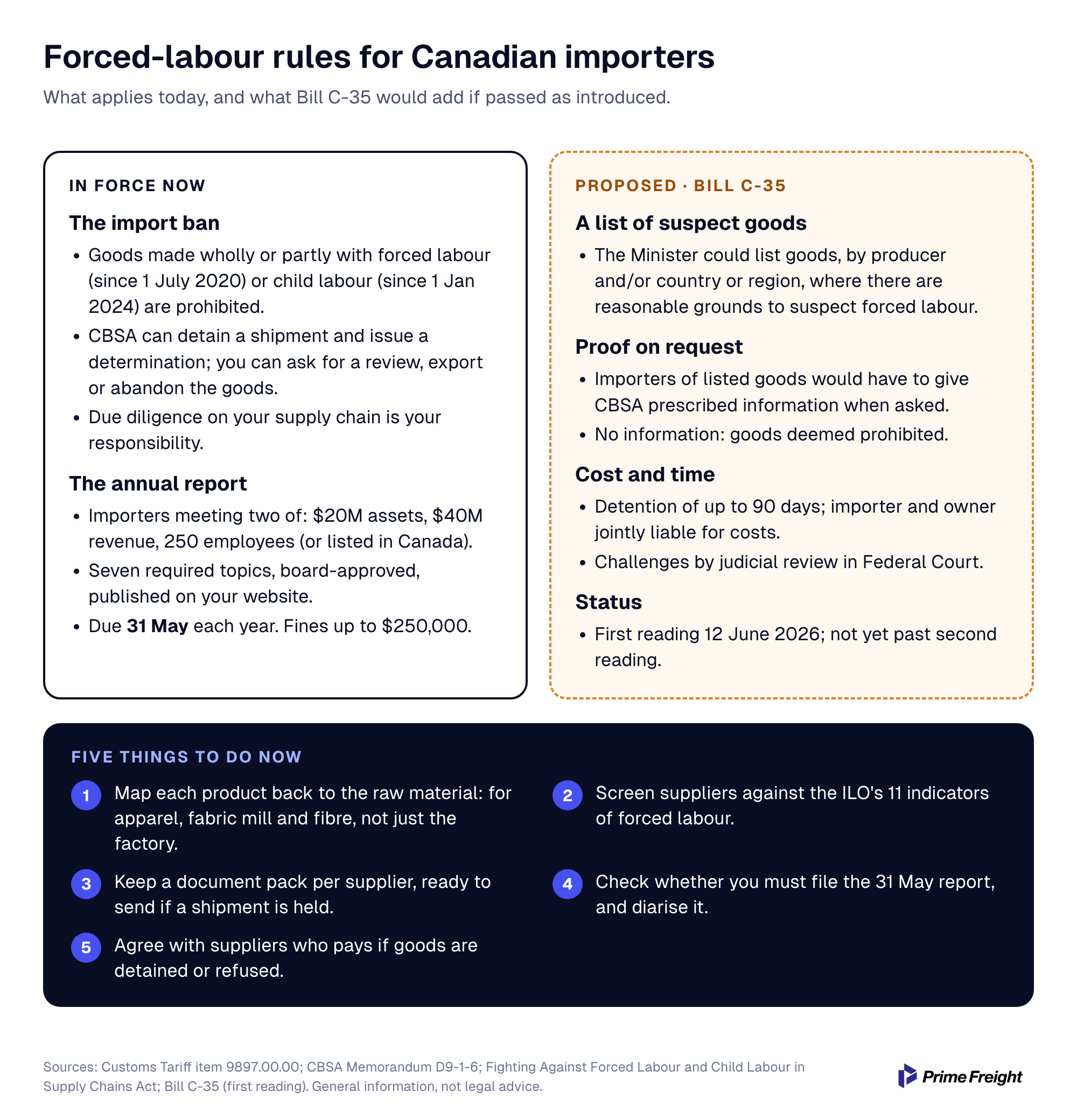
Customs Tariff item 9897.00.00 prohibits goods mined, manufactured or produced wholly or in part by forced labour. The ban took effect on 1 July 2020, and child labour was added on 1 January 2024. The CBSA's guidance is in Memorandum D9-1-6.
- Detention: the CBSA can hold goods it suspects, drawing on research by the federal Labour Program.
- Decision and review: you receive a determination and can ask for a review. Goods found prohibited can be exported or abandoned.
- Your responsibility: the CBSA says due diligence on the supply chain rests with the importer. An advance ruling on classification does not clear goods under the ban.
While goods are detained, storage and demurrage keep running on the container. That is often the first real cost.
2. The annual supply-chain report (in force)
The Fighting Against Forced Labour and Child Labour in Supply Chains Act requires some importers to report each year on the steps they take to prevent forced and child labour.
- Who: an entity listed on a Canadian stock exchange, or one with a place of business or assets in Canada that meets two of three tests in either of its last two financial years: $20 million in assets, $40 million in revenue, or an average of 250 employees. It applies if the entity imports goods produced outside Canada, or controls one that does.
- Which importer: Public Safety Canada's guidance treats the importer as the one that generally pays the duties. A company that buys from a third party that imports is not the importer.
- What: seven topics, from supply-chain structure and due diligence to remediation, training and how you measure effectiveness. The board approves it, a director signs an attestation, and it is published on your website.
- When: by 31 May each year; the next deadline is 31 May 2027.
- Penalty: fines of up to $250,000 on summary conviction, and directors and officers can be liable.
It is not a niche obligation: 4,313 reports were filed for the 31 May 2025 deadline.
3. What Bill C-35 would add (proposed)
Bill C-35, the Ban on Importing Goods Made with Forced Labour Act, had first reading on 12 June 2026. As introduced (text), it would:
- let the Minister list goods, by producer and/or by country or region, where there are reasonable grounds to suspect they were made with forced labour;
- require importers of listed goods to give the CBSA prescribed information when asked, with the goods deemed prohibited if they don't;
- allow detention for up to 90 days, with the importer and owner jointly liable for the costs;
- route challenges to judicial review in the Federal Court rather than the usual customs appeal.
The information requirements would come into force by order, and the details would be set in regulations, so there is no start date yet. The government has asked Parliament to pass the bill promptly, and on 8 October it published summaries of its consultation, which drew 129 participants and 73 written submissions.
What to do now
- Map the chain to the raw material. The government's guidance is to trace supply chains from sourcing the raw materials to the final product. For apparel, that means the fabric mill and the fibre, not just the cut-and-sew factory.
- Screen suppliers against the ILO's 11 indicators of forced labour, which the federal Labour Program points importers to.
- Keep a document pack per supplier: purchase orders, supplier declarations, audit reports and fabric or material sourcing records, ready to send if a shipment is held. Under Bill C-35, speed of response would decide whether goods are released.
- Check whether you must report by 31 May 2027, and give the work an owner now.
- Put detention in your contracts: agree with suppliers who carries the cost if goods are held, refused or have to be exported.
If a shipment is held at the border, tell us early: we can manage the container, storage and any re-export while the paperwork is sorted out. Contact info@primefreight.com.
This is general information from Government of Canada and Parliament sources checked on 28 October 2026, not legal advice. Bill C-35 may change before it passes.