
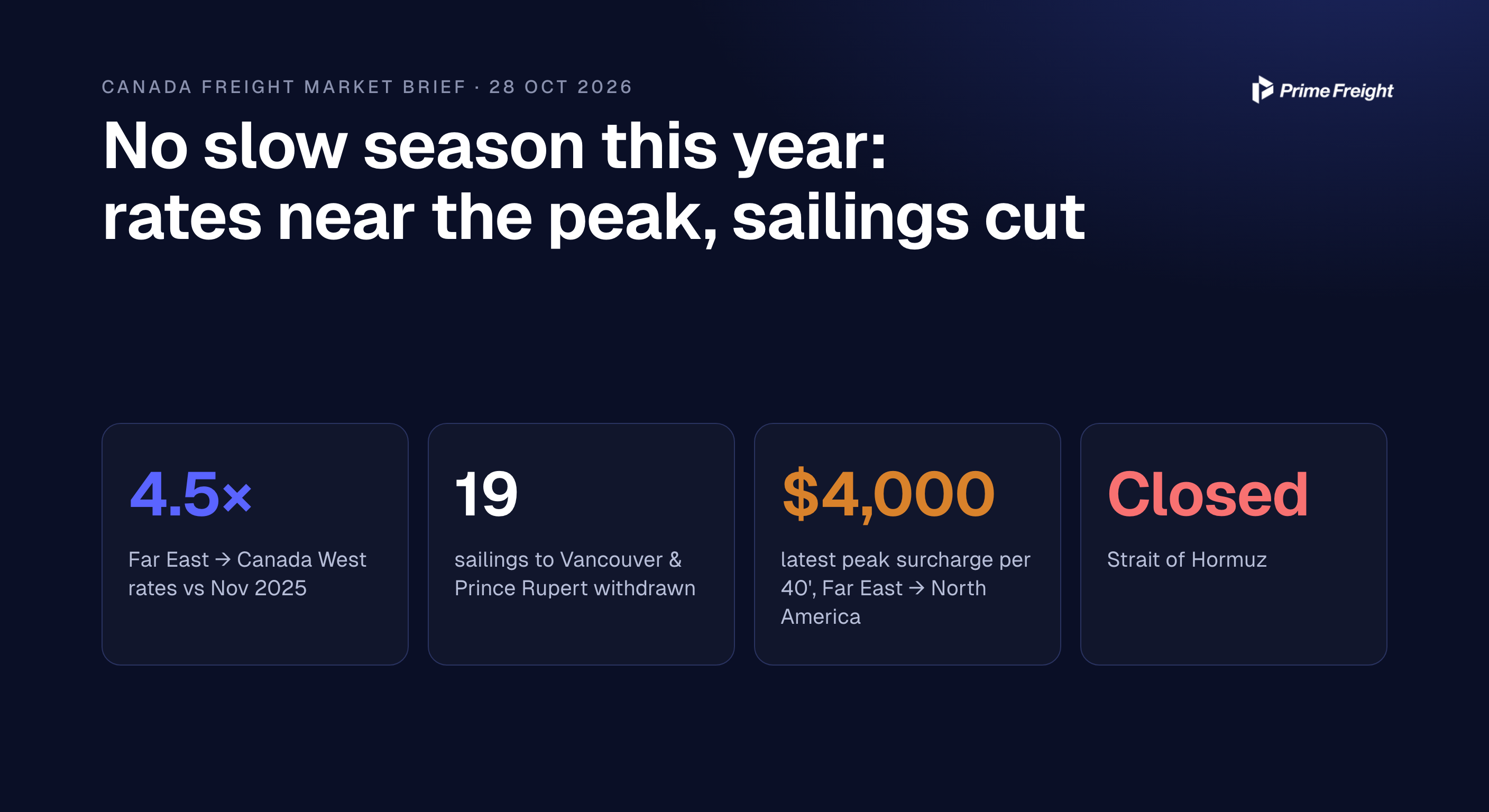
October is normally when ocean rates into North America soften. Not this year. Here is what our own market data shows for shippers into Canada this week, and what to do about it.
The short version
- Rates: our Far East → Canada West index is at 454 (November 2025 = 100), about 4.5 times last year. Canada East is at 279. Our forecast puts the peak in November and an easing into January.
- Surcharges: the latest peak-season surcharge filed for Far East → North America is $4,000 per 40' (effective 1 October), double the $2,000 typical of filings in May.
- Capacity: 19 departures to Vancouver and Prince Rupert scheduled between late October and early December have been withdrawn from carrier schedules.
- Risk: the Strait of Hormuz is closed, global schedule reliability is below 50%, and CN's main rail contract expires on 31 December.
Rates: November looks like the peak
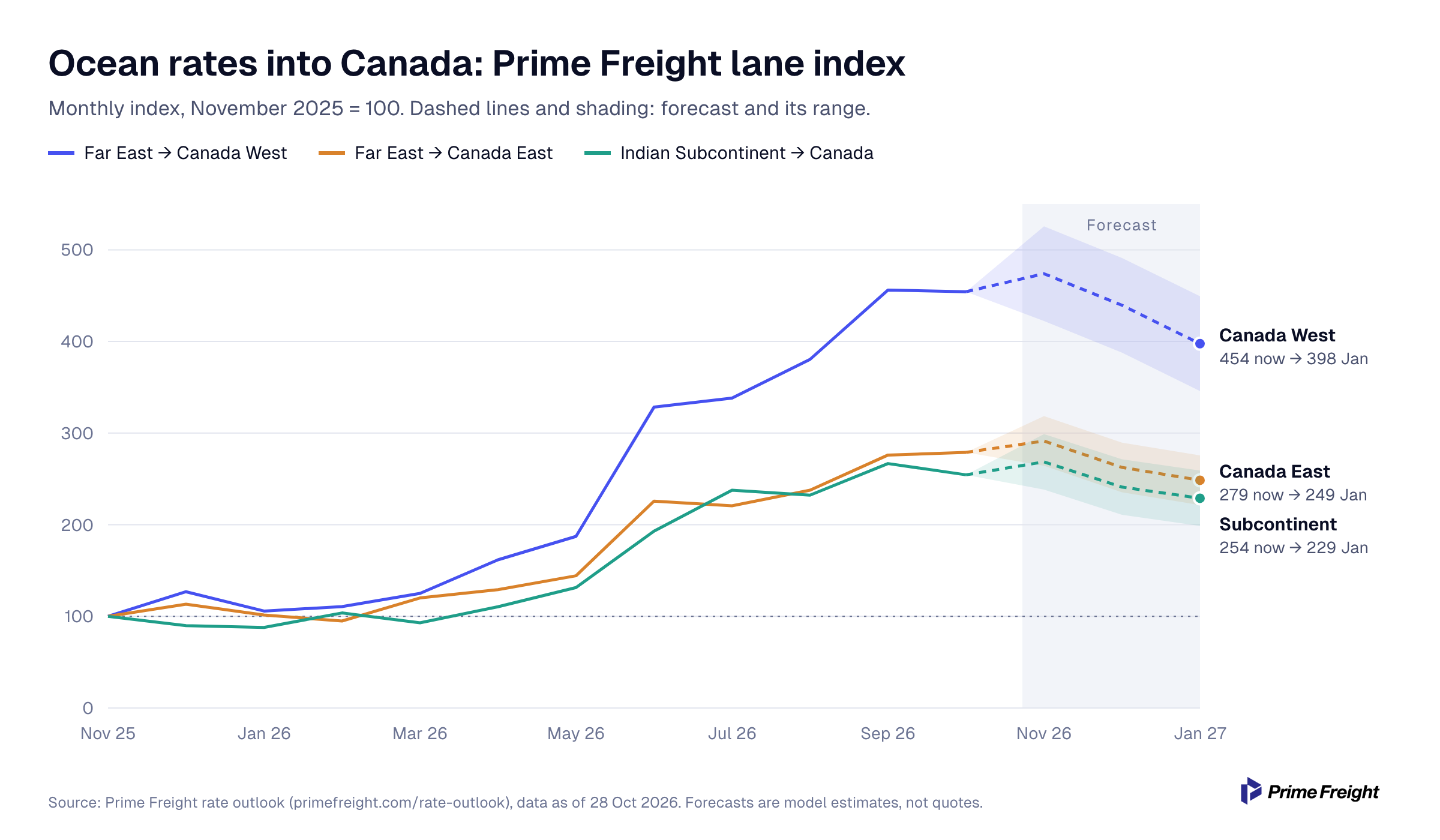
Our rate outlook tracks a monthly index for each lane, set to 100 in November 2025. Far East → Canada West stands at 454 for October. The forecast is 474 for November (range 422–526), then 398 by January. Far East → Canada East is at 279, forecast 291 in November and 249 in January. Indian Subcontinent → Canada is at 254, forecast 269 then 229.
The wider market agrees on the level. Drewry's World Container Index for 22 October had Shanghai–Los Angeles at $8,007 per 40' and Shanghai–New York at $10,166, both slightly up on the week, and Drewry expects transpacific rates to hold steady (Drewry).
What it means: even after the forecast easing, January rates would still be roughly two and a half to four times last November's. Budget Q1 landed costs on today's levels, not last year's.
Surcharges: still at the summer high
Our surcharge tracker reads carriers' published tariff notices. Peak-season surcharges filed for Far East → North America ran at about $2,000 per 40' in May; the most recent filing, effective 1 October, is $4,000 per 40' for all cargo from the Far East. Ask for peak-season and emergency surcharges to be shown separately on quotes, with their expiry dates, so you can see when they come off.
Capacity: sailings cut, schedules slipping
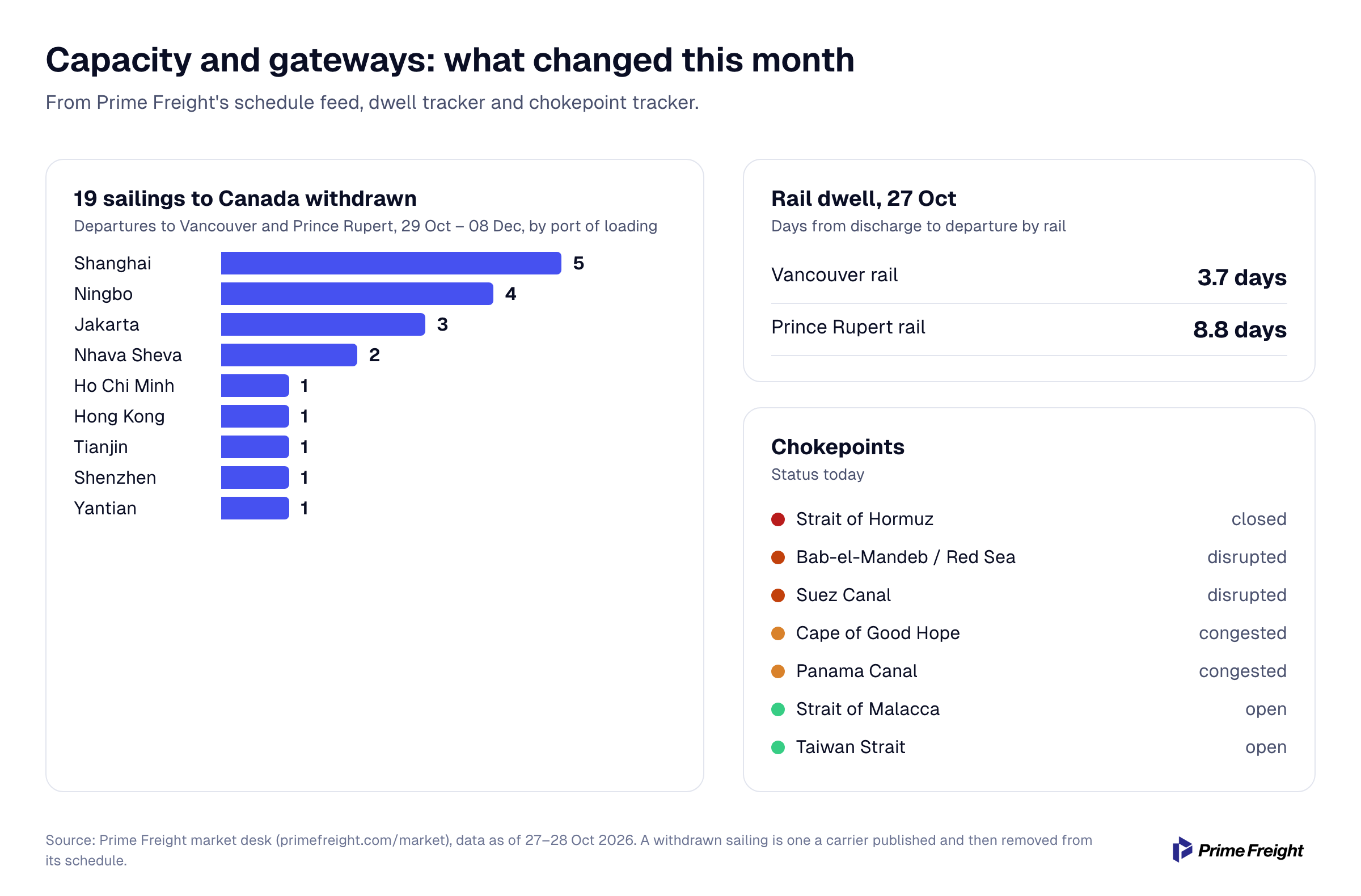
Our schedule feed compares what carriers publish from day to day. 19 departures to Canadian ports scheduled between 29 October and 8 December have since been withdrawn, 9 of them from Shanghai and Ningbo, and another 86 have been retimed. At the same time, typhoon-driven congestion at Asian ports has pushed global schedule reliability below 50% for the first time since the pandemic, and it is unlikely to clear before the Chinese New Year peak in February 2027 (Sea-Intelligence, via World Cargo News).
For December arrivals, book earlier than usual and confirm the vessel before your supplier trucks cargo to the port.
Gateways and chokepoints
- Rail out of the West Coast: on 27 October, containers waited 3.7 days for rail at Vancouver and 8.8 days at Prince Rupert (port dwell tracker). If inland timing matters, ask us about the gateway.
- Chokepoints: our chokepoint tracker shows the Strait of Hormuz closed, the Red Sea and Suez disrupted, and the Panama Canal and Cape of Good Hope congested. Carriers are steadily moving services back through Suez; see what that means for transit times.
Labour watch
- CN rail: the collective agreement with the Teamsters Canada Rail Conference, covering about 6,000 conductors and engineers, expires on 31 December 2026; bargaining meetings run through December (CN).
- BC ports: the West Coast longshore agreement runs to 31 March 2027.
- Back-to-work powers: Bill C-39, the Building Canada Strong Act, would set new requirements for when the Labour Minister directs the Canada Industrial Relations Board under section 107 of the Canada Labour Code. It passed second reading on 8 October and is in committee (openparliament.ca).
What to do now
- Book December and early-January sailings now, and keep a backup sailing in mind.
- Budget Q1 on current rates; treat any January easing as upside.
- Check every quote for peak-season and emergency surcharges and when they expire.
- For rail-heavy moves to Toronto and beyond, plan around the 31 December CN contract date.
- Order Chinese New Year stock early: the holiday falls on 6 February 2027.
Live numbers are on our market desk. To talk through your lanes, email info@primefreight.com.